
By Vasilis Lolides, correspondent of the Athens–Macedonian News Agency (ANA–MNA)
Gjirokaster, Korytsa, Kleisoura, Tepeleni, Saranda, Trebeshina — names and places that, every year around this time, on the eve of the October 28th anniversary, resurface in school celebrations, commemorative tributes, and perhaps in the memories of those whose families are connected to them through stories passed down from one generation to another.
Hearing these names, a student of history embarks on a mental journey stretching from Kalpaki in Ioannina and Annitsa in Grevena, across the Greek–Albanian border, to coastal, lowland, and mountainous landscapes — to the very places where the pages of the Epic of 1940 were written.

For decades, such remembrance could only be undertaken in thought. In recent years, however, visitors from Greece have travelled to Albania to encounter history in situ and pay homage to the soldiers who fought and fell during the Greco–Italian War, especially those whose remains, for nearly eight decades, had not been properly buried — the so-called unburied dead of 1940.
Visits to Sites of Historical Memory
A few days ago, two groups of visitors from Xanthi, Thessaloniki, Katerini, and Athens travelled to Albania on a pilgrimage of remembrance. The visit was organised by the Xanthi Branch of the Hellenic Army Retired Officers Association, which has been conducting this journey since 2015. The initiative offers participants the opportunity to visit places linked to the events of the Greco–Italian War, as well as sites significant to the spiritual, religious, cultural, and educational life of the Greek minority in Albania.
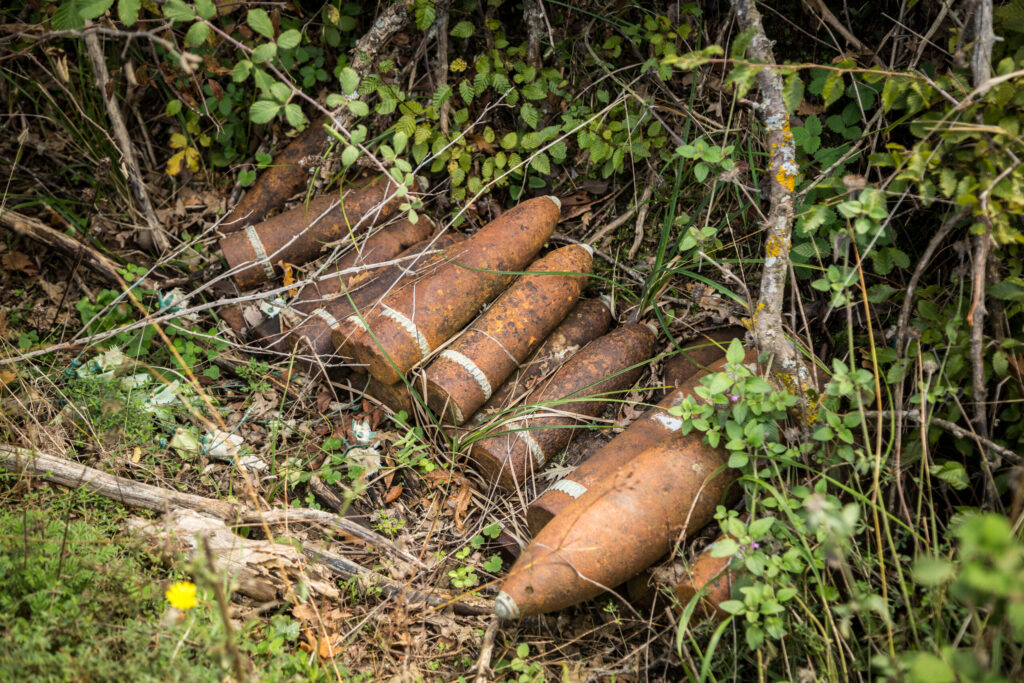
Among the participants was Nikos Kosmidis, PhD Candidate in Architecture at the Democritus University of Thrace and Coordinator of the project Actions for History, Memory and Culture. Speaking to ANA–MNA, Mr Kosmidis emphasised that “visiting the places where the events of 1940–1941 took place provides an opportunity to connect memory, history, family narratives, and landscape. In some cases, this connection is not easily achieved, especially when the passage of time alters the physical environment. Yet, in many of these sites in Albania, the connection remains both spatial and material. The soil itself — such as on Hill 731 — still bears witness to what happened there. War relics like bullets, shells, corroded metal fragments, and trenches in the earth offer tangible proof of a material bond with history.”
Honouring the Fallen of the Epic of 1940
Many are the stories of the known and unknown soldiers who gave their lives. One of the most moving, highlighted by Mr Kosmidis, is that of Ermioni Brigou, known as the “Mother of Himara.”
She was only nine years old when she met six Greek soldiers fighting in the region of Himara and formed a bond with them. When they were killed, she and her father buried them in the yard of their home. To this day, her family tends their resting place, and she remains willing to recount the story of the six soldiers she knew as a child. A modest memorial now stands in her courtyard to honour the six fallen Greek soldiers.

In 2018, an agreement was signed between Greece and Albania for the location and identification of the remains of unburied Greek soldiers found in mass graves — a memory that had been preserved and passed down through generations.
Mr Kosmidis, who had previously visited Albania in 2016 and now studies the relationship between space and memory, recalls: “I remember the first visit to a site in the area of Kleisoura, where there was testimony about a mass grave containing hundreds of fallen Greek fighters. At that time, the spot was marked only by a simple white cross. Today, the area is fenced and guarded, as the scientific team studies the recovered remains and works toward their identification.”
Nearby stands the Monastery of Saint Nicholas, where, under the guidance of His Beatitude Archbishop Anastasios of Tirana and All Albania, a cemetery was established for the eventual reburial of the recovered remains. “During this latest visit,” notes Mr Kosmidis, “we saw the once-empty tombs of the monastery now holding the bones of ‘many Greek sons,’ as mournfully sung in the traditional Northern Epirote lament.”
Since these individual and group pilgrimages from Greece began, relatives of fallen soldiers — now second and third generations — have finally been able to stand at the places where their ancestors gave their lives.
“As for us,” concludes Mr. Kosmidis, “we aim to offer this experiential connection with national and world history to the younger generation — the fourth generation — who never had the chance to hear firsthand the stories of what their forebears achieved through blood, pain, and sacrifice, but who can now approach and touch that history in the very soil where it was forever written.”
Last modified: 16 February 2026
[mc4wp_form id="5485"]