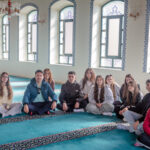

A group of students from the European School of Brussels 3 took part in a workshop on memory in contemporary Europe, organised by Actions for History, Memory and Culture on Tuesday, 21 April 2026. The workshop was held in the Kyriakos Stamatidis meeting hall at Tobacco Warehouse “P” in Xanthi, with the kind hospitality of the Foundation of Thracian Art and Tradition. The students visited Eastern Macedonia and Thrace as part of an educational trip designed to introduce them to the region, its culture and its people.
The group brought together students with family backgrounds from several countries, including the Czech Republic, France, Germany, Ireland, Italy, Slovakia, Spain and Turkey. They study in a multicultural school environment, and many come from families connected with European institutions and organisations, among them the European Union, the European Parliament and the permanent representations of EU Member States.

The workshop was presented by Nikos Kosmidis, PhD Candidate in Architecture at Democritus University of Thrace and coordinator of Actions for History, Memory and Culture. Andriani Loizidou, administrative secretary of the Association of Friends of the Foundation of Thracian Art and Tradition and α journalist, was also present to welcome the group.
The meeting focused on the place of memory in contemporary Europe and on the ways societies remember, interpret and give new meaning to the past. Memory was presented not as something fixed or confined to the past, but as a dynamic, evolving and often contested process, shaped by recognition and silence, interpretation and public representation.
Particular attention was given to the relationship between memory and place. The discussion explored how military cemeteries, memorials, former concentration camps and sites of violence against civilians can become places where memory is carried, questioned and discussed. These places do not simply preserve the past. They also shape how it is experienced, understood and discussed in the present.
The workshop also addressed memory as a public and European issue. European societies share major historical experiences, but they do not always remember them in the same way. Different national narratives, losses, silences and political interpretations form a shared but complex field of remembrance. In this context, the students discussed how a European memory might be shaped in today’s international environment without erasing differences, while still allowing space for democratic dialogue.
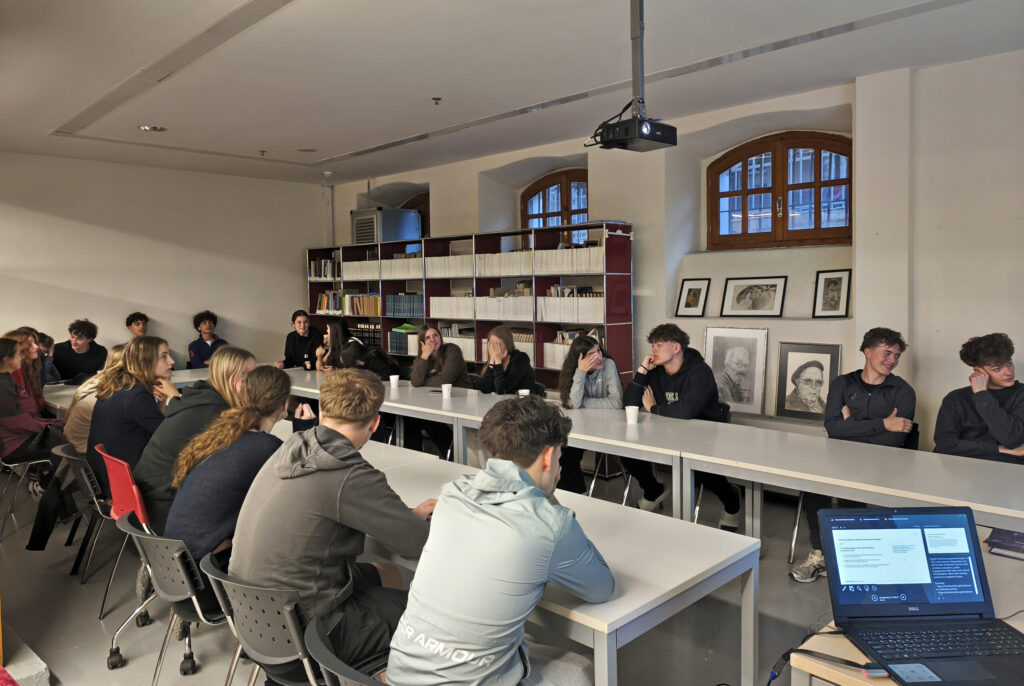
A central part of the discussion focused on the role of young Europeans. Many young people, including students at international schools, grow up between different languages, cultures and national memories. This does not make memory less important. Rather, it makes it more complex and more necessary. Several students, some of whom hold dual citizenship, shared experiences from their own backgrounds and joined the discussion on memory as inheritance, responsibility and a space for critical reflection.
The meeting concluded with an open discussion on the possibility of building a shared European memory without eliminating differences, the role of institutions in public remembrance, the importance of memory sites for younger generations and the point at which remembrance becomes responsibility.
Last modified: 3 May 2026
[mc4wp_form id="5485"]