
The opportunity to participate in the commemorative events marking 110 years since the ANZAC landing at Gallipoli was made possible for 40 individuals from Xanthi, Athens, Thessaloniki, Serres, Drama, Komotini, Alexandroupoli, Orestiada, as well as from France, through the program Actions for History, Memory and Culture and the Foundation of Thracian Art and Tradition.
This year’s journey built upon and expanded the scope of last year’s corresponding initiative, which combined historical exploration with an introduction to monumental architecture and the dynamics of public memory. These themes were presented by the program’s coordinator, Nikos Kosmidis (PhD candidate in Architecture), and Andreas Matzakos (PhD candidate in History and Director of the Foundation of Thracian Art and Tradition).
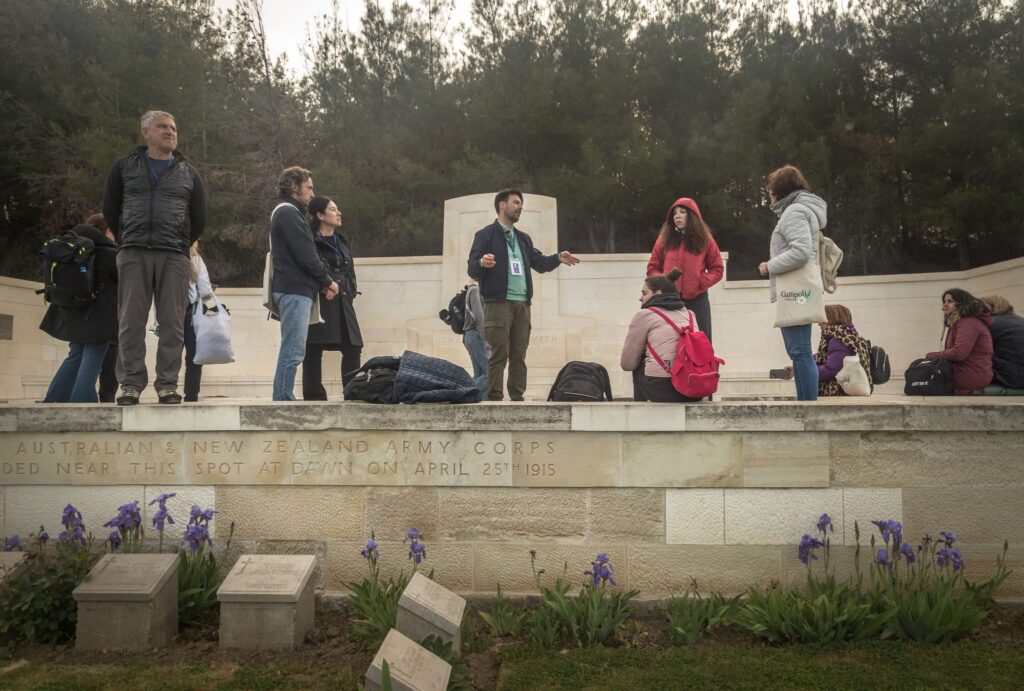
Participants visited several military cemeteries across the Gallipoli peninsula and engaged with Mr. Kosmidis’s interpretive approach. Special emphasis was placed on the architecture of memory, particularly the work of the renowned British architect Sir Edwin Lutyens, who shaped the design of many Commonwealth war cemeteries and memorials after the First World War. His austere yet powerful style—based on geometric clarity and respect for the landscape—helped establish a global symbol of collective remembrance and silence. The cemeteries are maintained by the Commonwealth War Graves Commission (CWGC), which ensures that fallen soldiers of all nationalities are remembered with dignity and respect.

At the Ari Burnu military cemetery, poems written by soldiers of the time were read aloud, conveying the thoughts, fears, and emotions of young men who found themselves on the front lines during the Gallipoli Campaign (1915–1916), offering a literary connection to the lived experience of war.
During this year’s trip, participants had the unique opportunity to attend the official commemorative ceremonies organised by the governments of Australia and New Zealand. The anniversary events, attended by representatives from several foreign countries, including the Prime Minister of New Zealand and Princess Anne of the United Kingdom, were held at the historical landing site known as ANZAC Cove, as well as at the Lone Pine Allied Cemetery and Memorial.
The ceremony on April 25, 2025, was marked by emotional intensity and deep symbolism. Princess Anne read excerpts from letters written by soldiers of the time, while New Zealand Prime Minister Christopher Luxon emphasised the importance of preserving historical memory and preventing future conflicts. Also present was Sam Mostyn, Governor-General of Australia. The ceremonies included wreath-laying, prayers, and a moment of silence in honour of the fallen, underscoring the enduring impact of the Gallipoli Campaign on the national identities of Australia and New Zealand.

Each year, the Day of Remembrance brings to this distant place descendants of Australian, New Zealand, and Māori soldiers—third, fourth, and fifth generations—who journey to the site where their ancestors were killed or to which their families remain emotionally and historically connected. The ceremonies of remembrance incorporate elements from the national identities of the Commonwealth countries, as well as from the indigenous cultures of Australia and New Zealand.

The day also included a walking tour through the protected area, along forested paths that pass by smaller and larger military cemeteries.
The visit to Gallipoli was complemented by a stop on the island of Tenedos, where the group from Greece participated in the religious celebrations of the small local Greek community at the chapel of Saint George, which welcomed them with warmth and emotion.
Last modified: 9 August 2025
[mc4wp_form id="5485"]

