
Interview originally published by Vasilis Lolides, correspondent for the Athens-Macedonian News Agency (AMNA)
Eighty years after the end of the Second World War and seventy-five years after the Schuman Declaration, which laid the foundations of European unification, Europe will once again commemorate these two anniversaries amid ongoing military conflicts, both within and beyond its borders. Places where critical historical events took place play a central role in this year’s commemorations. Germany is at the centre of these events, both because of the anniversary of the fall of the Third Reich and the 80 years since the liberation of many Nazi concentration camps.
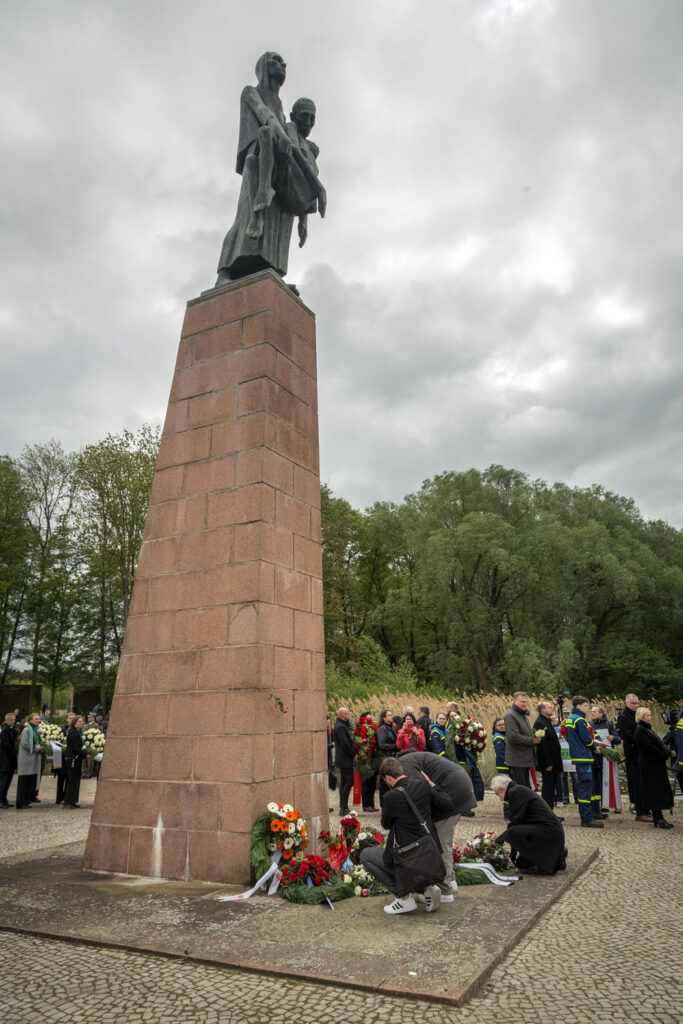
Nikos Kosmidis, coordinator of the program History, Memory and Culture Actions, participated in the three-day events marking the 80th anniversary of the liberation of the Ravensbrück concentration camp, in the federal state of Mecklenburg. The camp, which operated from 1939 to 1945 and was liberated by Soviet troops, was the largest Nazi concentration and forced labour camp for women. Among those imprisoned at Ravensbrück were Christian, Jewish, lesbian, Jehovah’s Witness, Roma, and Sinti women, as well as women whom the Nazi regime labelled as “asocial.”
For Mr. Kosmidis, PhD candidate in Architecture at the Democritus University of Thrace (DUTH), the site—as he stated to the Athens-Macedonian News Agency (AMNA)—is a place of shared suffering for people from different social and cultural backgrounds. As he noted, “Solidarity among them was not always a given, and likewise, coexistence and a shared way of remembrance are not self-evident today either, as each group commemorates its own dead through its symbols and narratives.”

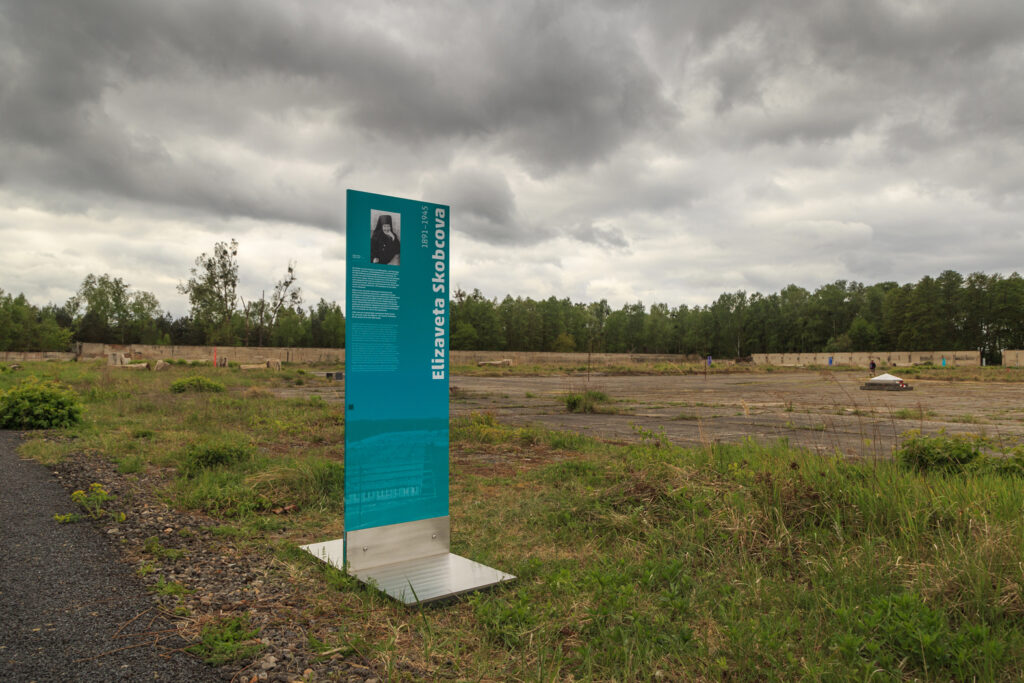
For Orthodox Christians, Ravensbrück is associated with the martyrdom of Maria Skobtsova. Of Russian noble descent, she had participated in the early stages of the Russian Revolution and later fled to Paris, where she developed a spiritual, social, and charitable presence as an intellectual, artist, theologian, and later as an Orthodox nun. She took an active part in the French Resistance, helping to save Jews. For her resistance activity, she was sent to Ravensbrück, where she was martyred on March 31, 1945. In 2004, the Ecumenical Patriarchate of Constantinople recognised her as an Orthodox neomartyr, together with her collaborators Fr. Dimitri Klepinin, her son Yuri, and Ilya Fondaminsky.
Mr. Kosmidis has, in recent years, been researching the connection between architecture, politics, and theology in sites of martyrdom, as part of his doctoral dissertation under the supervision of Professor Giannis Kolokotronis. He attended various commemorative ceremonies organised by feminist, anti-fascist, and lesbian organisations, as well as by national delegations. Of particular interest, as he told AMNA, is the different way of remembering the victims, expressed through the slogans, banners, and symbols used by each group.
“The Polish delegation, for example, inaugurated a new monument at the site, inspired by religious imagery, depicting the Virgin Mary with the infant Jesus. The inauguration took place in the presence of Maria Lorens, daughter of the former prisoner Katarzyna Mateja, who had been imprisoned for her resistance activity, inspired by her Roman Catholic faith.”

The national delegations also included the Greek one, which honored the memory of approximately 400 women and men from Greece, whose names were read aloud at the point where the word “Griechenland” (Greece) is inscribed along the Avenue of Nations. Ashes from the nearby crematorium of the former camp had been found at this location.
The ceremony was organized by the group of Greek Friends of Ravensbrück in Berlin (Griechischer Ravensbrück Freundeskreis Berlin), led by Eleni Winckel-Moraitou, a member of the International Ravensbrück Committee. The Consul of Greece in Berlin, Elias-Andreas Klouvatos, announced Greece’s intention to create a memorial space dedicated to the Greek prisoners, as other countries have already done.
During his time there, Nikos Kosmidis had the opportunity to speak with Ivan Lefkovits, a survivor of both Ravensbrück and Bergen-Belsen, who was liberated by British forces amid piles of unburied corpses, as he recounted to the participants of the events. “Our conversation,” Kosmidis emphasized, “focused on the question: what will happen when the last concentration camp survivor is no longer with us? How will the memory of the horror of the Nazi camps be preserved without becoming institutionalized in a way that alienates people from collective understanding and participation?” Mr. Lefkovits agreed with this concern, stressing that it is our duty to ensure that the world never stops learning what happened in these horrifying places of industrialized death.”
“Participating in the ceremonies and visiting other memorial sites, such as the Plötzensee prison and execution site—where four Greeks aged 19 to 34 were executed—is not just an emotionally charged experience, but also a ‘laboratory’ for understanding today’s politics of memory,” Nikos Kosmidis emphasized in his remarks to AMNA.
“Today’s anniversary,” he noted, “is not merely a reminder of a dark past, but a call to remember—if the current images from war zones around the world are not enough for us—what war, militarism, fascism, and violence against civilians really mean. This need to highlight such dimensions of memory is also promoted by the program History, Memory and Culture Actions, which began in Xanthi and the Region of Eastern Macedonia and Thrace. In its four years of operation, it has established collaborations with local authorities, the academic and educational community, and memorial institutions in Greece and abroad.”

Last modified: 7 August 2025
[mc4wp_form id="5485"]

