
The Greek summer, beyond its bright facade, summons dark anniversaries into collective memory. Across the country, atrocities committed by occupying forces—sometimes with the active involvement of local collaborators—are commemorated, permanently marking the land and identity of entire communities. Martyred communities such as Kondomari (Chania, June 2, 1941), Kandanos (June 3, 1941), Distomo (Boeotia, June 10, 1944), Ypati (Phthiotis, June 17, 1944), Kosmati (Grevena, July 9, 1944), Lechovo (Florina, July 23, 1943), Kommeno (Arta, August 16, 1943), Chortiatis (Thessaloniki, September 2, 1944), and Ano Karyofyto (Xanthi, September 9, 1944) evoke in the public sphere the memory of their victims.

Commemorative ceremonies—sometimes modest, sometimes broadly attended—underscore that the occupiers’ brutality was not isolated or accidental, but part of a systematic intimidation strategy across occupied Europe aimed at suppressing Resistance. Beyond their emotional impact, such anniversaries raise crucial questions: how do we, as a society and as a State, deal today with the memory of these crimes? And how can this memory be linked to current European policies and demands for justice, restitution, and international recognition?


From Ritual to Strategic Memory
In Greece, memory is often approached through commemorative rituals without meaningful dialogue with the past. Observers of similar processes abroad find them more complex and closely tied to international politics and geopolitical developments.
In this context, a recent conference held at the Orthodox Academy of Crete, focusing on memory, oblivion, and the issue of German reparations, with participants including former President Prokopis Pavlopoulos and Mayor of Kalavryta Athanasios Papadopoulos, President of the Network of Martyred Towns and Villages, offered a different model beyond ceremonial formality. The event, in which we participated on behalf of the Actions for History, Memory and Culture project and the mnemonikon.gr platform demonstrated memory as a social and political act—not confined to ritual, but conversant with current historical relevance. The presence of institutional representatives alongside those from martyred communities reminds us that shaping a national memory strategy is not a monologue, but a process of collective responsibility that requires active participation and coordination.
Especially regarding crimes of the Triple Axis Occupation (German, Italian, and Bulgarian forces), the Network plays a pivotal role in bringing the history of martyred communities to national and international attention. Representatives from regions suffering demographic decline continue to battle to preserve the memory of atrocities by German, Italian, and Bulgarian occupying forces, as well as the hardships of post-war reconstruction in deeply traumatized places.
At such public memory anniversaries, remembrance of the Nazi crimes intersects with demands for justice and reparation. During the OAC conference, steps in this direction were proposed, and the importance of internationalizing Greek demands was emphasized.

The memory of more or less well-known martyr sites needs to be further connected with similar memories in other countries—and with corresponding demands for tangible justice, not only rhetorical acknowledgement of historical guilt. What is needed is a comprehensive framework for memory management, as part of Greece’s soft diplomacy.
Justice and Compromises in Contentious Memory Landscapes
For decades, communities have borne the burden of remembrance, keeping collective memory alive under difficult circumstances; now the State must co-shape a strategic framework with them. After all, a coherent national memory strategy cannot emerge unilaterally. It requires dialogue among the martyred communities themselves, memorial sites and museums, memory studies researchers, and, of course, institutional State bodies. In the absence of central coordination and institutional orientation by the State, even the most valuable individual efforts fall short of producing impact at the international level. Without a comprehensive plan—even for managing memory sites—gaps are often filled by third-party interventions that can be divisive and distracting from the core demand: meaningful historical redress. Recently, the involvement of private interests in collective memory issues has been observed, with implications for public functionality.
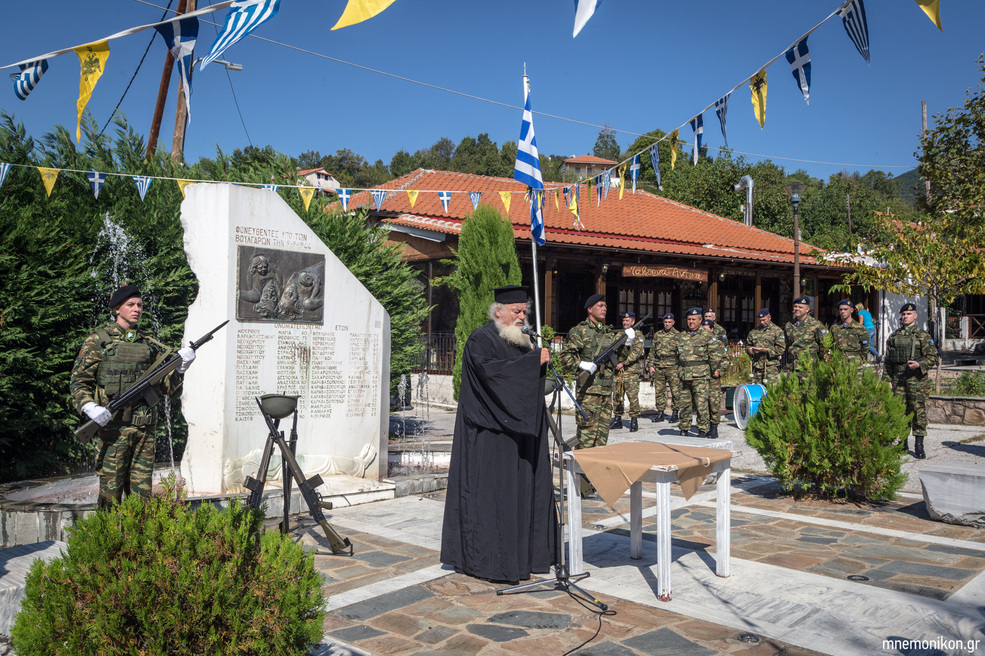

The State must integrate memory into a national strategy that links historical responsibility with the country’s contemporary international standing. In such a framework, historical memory can serve to strengthen the Greek people’s collective identity. Furthermore, it can serve as a lever for enhancing Greece’s international image, promoting cultural diplomacy, and fostering trust-based relations with other nations and societies.
The State’s commitment was apparent, among other things, in the unanimous decision by the Hellenic Parliament’s plenary on April 17, 2019, reaffirming the active, imprescriptible, and legally enforceable nature of Greek claims. Yet since then, this parliamentary resolve has yet to crystallize into a coherent policy and government strategy. Collective memory is not neutral—it is shaped through conflicts, contradictions, and social struggles.
Nikos Kosmidis – PhD Candidate in Architecture, Democritus University of Thrace

Last modified: 14 October 2025
[mc4wp_form id="5485"]

