
Educators from Thessaloniki and the wider region of Central Macedonia, along with university students, participated in the educational workshop “Memory, Theology and Education in Dialogue,” held on Saturday, 17 January 2026.
The workshop was co-organised by the Panhellenic Theological Association “Kairos” (Central Macedonia branch) and the programme Actions for History, Memory and Culture, with the support of the Foundation of the Museum for the Macedonian Struggle and the Modern History of Macedonia.
Participants were welcomed by Professor Stavroula Mavrogeni, Director of the Centre for Research on Macedonian History and Documentation, who highlighted the role of museums as institutions of historical memory that promote a reflective and substantive understanding of history beyond narrow or nationalistic frameworks. She also referred to the workshop’s connection with the photographic exhibition “Sites of Memory, Places of Martyrdom” by Nikos Kosmidis, currently hosted at the Museum.

In his address, Professor Petros Panagiotopoulos, President of the “Kairos” Association, reflected on the theological dimension of memory as a field through which historical responsibility is reconsidered across generations. He emphasised the importance of a theological perspective that engages critically with the present, and thanked Grigoris Mavrokostidis, who coordinated the event, for his contribution to a workshop that opens new possibilities for dialogue.
Presenting the exhibition, Grigoris Mavrokostidis described it as a photographic reflection marking 80 years since the end of the Second World War, underlining its strong educational orientation and encouraging its use in school contexts.
In his introductory remarks, Nikos Kosmidis referred to the exhibition’s universal character, bringing into dialogue history, architecture, and theology through sites of war, persecution, and resistance across Europe. He noted that the workshop coincided with the Week of Prayer for Christian Unity, drawing a parallel between the theological aspiration to overcome divisions and the broader historical effort, particularly after 1945, to move beyond the violence of war.
Kosmidis emphasised the importance of sites of memory—especially concentration and extermination camps—as spaces for the cultivation of historical understanding, while also pointing to the risks of their instrumentalisation in the contemporary context. Drawing on observations of visitor behaviour and discussions with professionals in the field, he underlined that historical empathy cannot be assumed, even among participants in educational programmes on the Holocaust.

The discussion that followed addressed the management of memory sites in Greece in comparison with international practices. Particular emphasis was placed on the absence of a coherent national approach and on the limited institutional prioritisation of historically significant sites, with implications for collective identity, cultural diplomacy, and how younger generations engage with the past.
Drawing on the programme’s experience with school communities, two indicative case studies were presented.
The first concerned the martyred village of Kosmati (Grevena), where Nazi German forces executed the male civilian population. Within the framework of the programme, students conducted a structured historical walk at the site of the massacre, engaging with lived history through encounters with the last surviving witnesses.
The second focused on school participation in the Regional Commemoration 1943–2023, dedicated to the Greek Jews of Eastern Macedonia and Thrace who were deported to Treblinka. Students of Christian and Muslim backgrounds visited the restored Jewish cemetery of Xanthi and other related sites, exploring the pre-war Jewish presence and the events of March 1943.
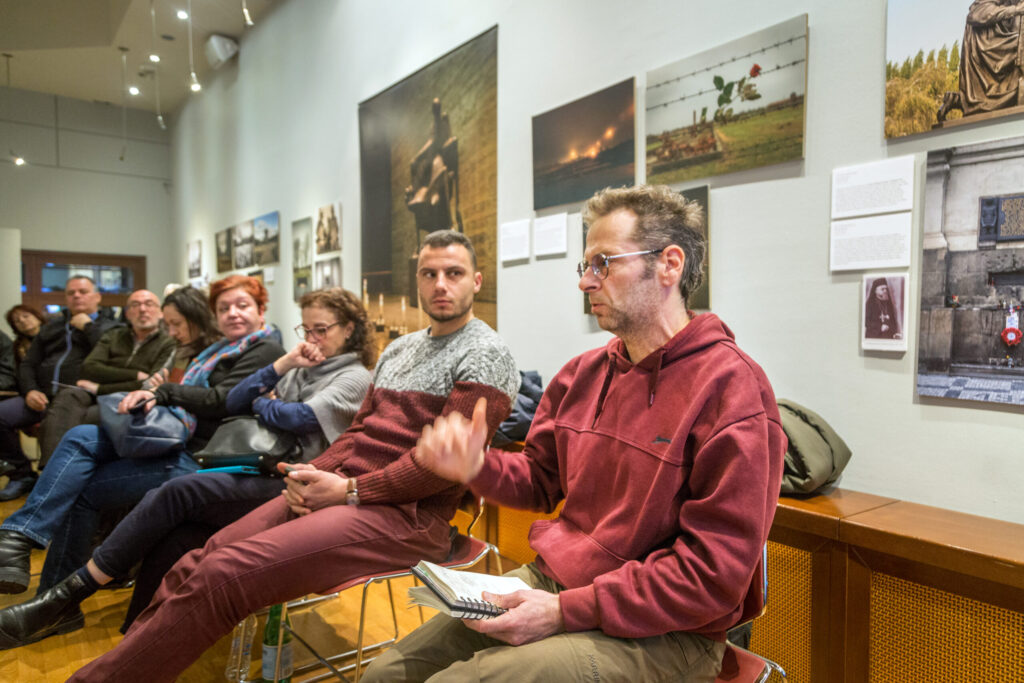
This experience was further discussed by educator Theodoros Sarafidis, who highlighted how student engagement developed through dialogue and open participation, in some cases leading to independent research and the production of educational material on the Holocaust.
The workshop concluded with an active exchange between speakers and participants, focusing on the role of the school not merely as a setting for the implementation of educational programmes, but as a space for meaningful engagement with complex historical and ethical questions.
Education advisors and teachers expressed interest in further collaboration with the programme Actions for History, Memory and Culture, and proposals were discussed for future initiatives aimed at highlighting the historical significance of memory sites in the wider Thessaloniki region.

Last modified: 16 April 2026
[mc4wp_form id="5485"]